
Communities: The First Responders
Published: Aug 19, 2026 Reading time: 5 minutes Share: Share an articleWhen disaster strikes, the arrival of humanitarian agencies is rarely the beginning of the response. Across the globe, communities facing floods, heatwaves, and other climate-induced disasters are nearly always the first to act. . The question is how prudent those first decisions and the first acts are? At the heart of our Resilience, Adaptation and Inclusion in Nepal (RAIN) programme, lies the community led approaches to strengthen community resilience, early warning systems, and early action that guides people’s decisions during impending pressures.
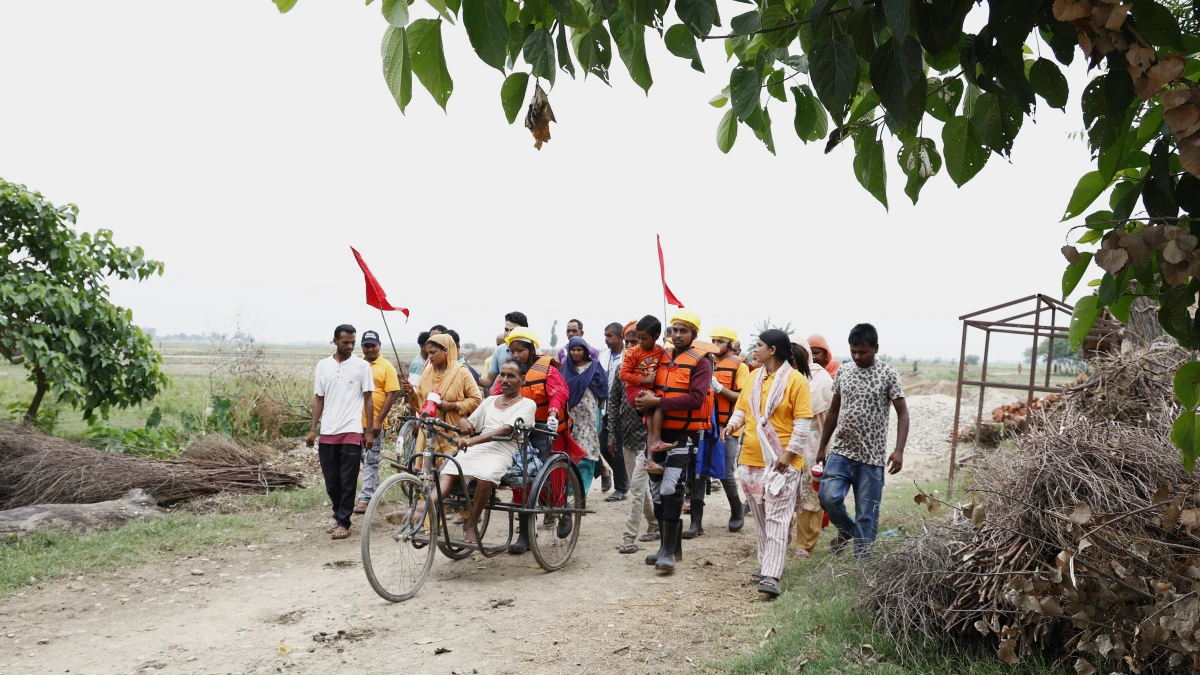
For Jubeda Khatun, Vice-President of the Community Disaster Management Committee (CDMC) in Narainapur, the difference between reaction and preparation became clear after participating in a mock flood drill.
"In the past, we used to sit for a meeting after the flood. We would act only after the flood entered the village. But this approach had consequences. People and their cattle would become stranded, crops and belongings would be destroyed, and sometimes lives were lost."
The mock drill helped community members understand that every minute matters—before a disaster occurs and the existing science is capable of sharing the flood alerts in advance and that community themselves have the agency to take early action before the disaster.
"After participating in the drill, we realised the need for proper communication, coordination and planning. Now, when we receive an alert in the CDMC WhatsApp group, we immediately call a meeting, verify the information with local government authorities, mobilise volunteers, make community announcements, and visit the homes of senipr citizens and persons with disabilities to ensure they are informed and prepared. This drill made our role in early action much clearer."
Her experience also highlights another critical aspect of humanitarian response: dignity and inclusion.
Having completed a seven-day Volunteer Mobilisation Training, Jubeda learned about first aid, flood response, and fire response. But the training also helped address concerns often overlooked during emergencies.
"Floods affect everyone, but girls and women are affected differently. Rescue operations are mostly led by men, and many women and girls in our community feel uncomfortable during rescue operations. Now that several women, including myself, have received rescue training, we can support women in a way that respects their dignity and makes them feel safer." Training women as volunteers, especially addresses and solves the hidden difficulties that women and girls often face during disaster emergencies. In many communities, deep-rooted social and cultural norms discourage physical contact between people of different genders. Having trained women volunteers in the community helps ensure that women and girls can be evacuated safely and with dignity.
For Jubeda, the value of the training goes beyond this year's monsoon season. Floods will continue to affect Narainapur, and the people present when the water rises are the same people who live in the community every day.
Perhaps most importantly, she sees community preparedness as a lasting investment.
"The project will be gone, but we have to stay here. The skills we have learned and the training we have received will be useful for us, forever. We live in this community. People know us and trust us."
Narainapur in Banke district lies among some of the most flood-prone areas of south western Nepal. Every monsoon season brings uncertainty and risk to families living between rivers that frequently overflow their banks.
For Hem Kumar Mauriya, Treasurer of the Narainapur CDMC, community preparedness means combining local knowledge with new skills and equipment.
"Our village is surrounded by three rivers. During the monsoon, floodwaters can rise four to five feet. Our elders had indigenous knowledge. They knew how to swim and respond to floods. But with time and changing climate patterns, much of that knowledge has been lost."
Before receiving training, community members often risked their own lives to save others.
"We used to jump into the river to rescue people during floods. We did not have life jackets or other safety measures. Now we have received training, search and rescue kits, life jackets, ropes, boots and other equipment. We have learned that saving our own lives should be the first priority before rescuing others."
The training brought a profound shift in mindset.
"We learned that we must remain patient during emergencies. If we panic, we cannot think clearly. Instead of rushing into dangerous floodwaters, we assess the situation and respond safely."
Hem believes that local people will always remain the first line of response during crises.
"In emergencies, villagers are the first people to respond and support. Other institutions arrive later. We can run to safer places, but children, older people, persons with disabilities, pregnant women and lactating mothers may struggle. It is our responsibility to support them."
“We are now better equipped, and the community trusts us."
The RAIN programme's emphasis on localisation and strengthening community-based organisations recognises that sustainable humanitarian action begins with local leadership and preparedness. Communities that are equipped with knowledge, resources, and decision-making power can better anticipate risks, act early, and protect those most vulnerable. RAIN programme has linked the Early Warning System with Narainapur Municipality, but its most importantly it is enabling communities to understand that floods can be forecasted , warnings are available, and timely action is possible. The aim is to make sure community interpret early warnings and make prudent, timely decisions based on available information, rather than waiting for floods to occur before responding
This World Humanitarian Day, we celebrate the everyday humanitarians whose actions often go unseen but whose impact is immeasurable. From sharing an early warning message to carrying out a rescue, from checking on an elderly neighbour to ensuring women and girls are supported with dignity, communities continue to demonstrate that the most effective first responders are often those closest to the crisis.
RAIN is funded by UK International Development, led by People in Need (PIN), co-led by DCA in Nepal, Community Self Reliance Centre (CSRC), Local Initiatives for Biodiversity, Research and Development (LI-BIRD), Prerana, Youth Innovation Lab, Red Cross Red Crescent Climate Centre and Met Office.


