
Lydia’s sorghum journey in the Barotse Floodplains
Published: Jun 25, 2026 Reading time: 6 minutes Share: Share an articleIn Lukulo, a community in Zambia’s Western Province, Lydia Muimui grows sorghum. She works with determination to make the season a success. As the red grain matures, she is already calculating school fees she needs to pay. However, she is also showing how community-led agriculture is proactive and adaptive. It is based on local knowledge built over generations, and strengthened through new opportunities and training.
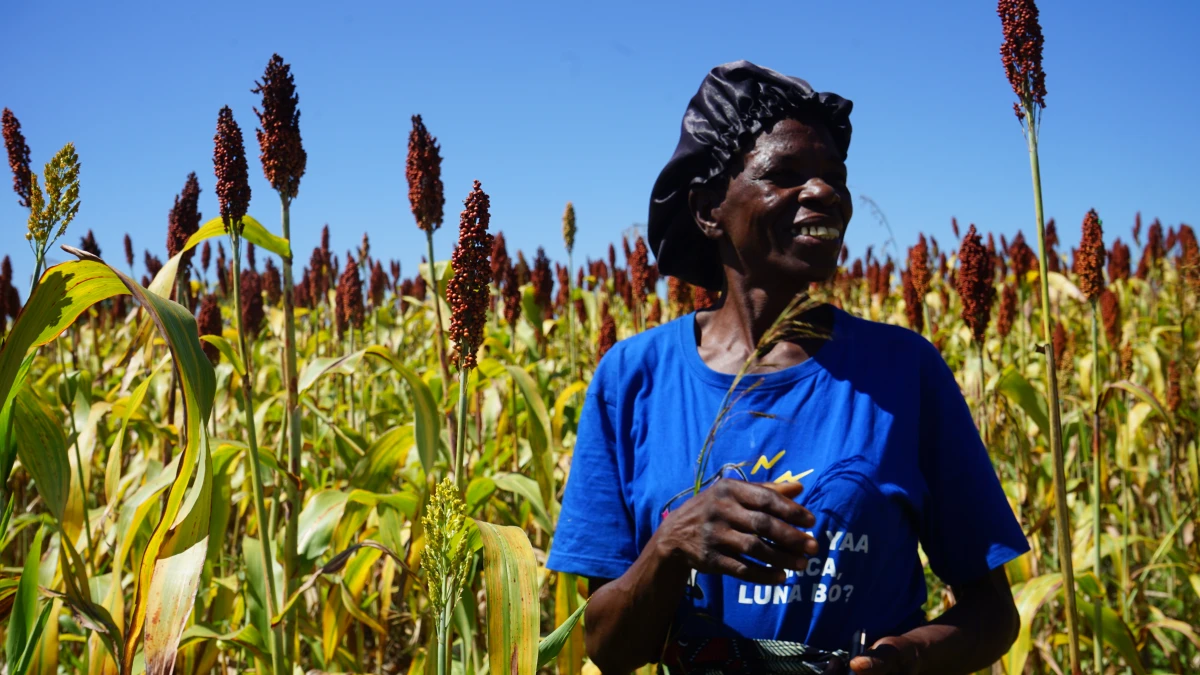
Lydia Nastiwitwi Muimui is the lead farmer and treasurer of Malumbwe Community Forest, a Community Forest Management Group in Mongu district. She leads 17 of 50 farmers we trained in sorghum production. This training was undertaken through our Enhancing Livelihood Opportunities through Ecosystems Protection in the Barotse Floodplains project.
Together with WWF Zambia and Easy General Dealers, we supported farmers with training in sorghum production, access to seed, and market opportunities for their harvest.
The sorghum we provided differs from varieties previously grown in the area. The red variety introduced through the project is better suited to increasingly common conditions across Western Zambia, including irregular rainfall and shorter growing seasons.

In Lydia’s words:
Lydia's observation reflects why sorghum is attracting increased attention across Zambia. The crop requires less water than maize, tolerates periods of drought, and can recover when rainfall returns. In areas facing increasingly unpredictable weather patterns, these characteristics can make the difference between a productive season and a failed harvest.
Growing with confidence
But growing resilient crops is only part of the equation. Farmers also need the confidence that there will be a market for what they produce.
Before the first seed was planted, we worked with Easy General Dealers, a Mongu-based enterprise specialising in organic grain products and eco-friendly charcoal briquettes, to establish a reliable market for participating farmers.
The company processes cassava, millet, and sorghum products and was identified as a ready buyer for the harvest produced by farmers in Lukulo. This arrangement addresses the farmers’ uncertainty about who will buy their produce and at what price.
By connecting farmers directly to a buyer, we helped create greater confidence that their harvest would have a market.
Sorghum is attracting growing demand in Zambia, particularly among consumers seeking healthier alternatives to refined grains. Its low glycaemic index and nutritional value have made it increasingly popular among people managing diabetes and related health conditions.
For Lydia, the figures are straightforward. A 50-kilogram bag of sorghum sells for approximately 500 kwacha (€24).

The season that did not go to plan
Farming in Lukulo, like everywhere, is time-sensitive. When the rains begin, ploughing must follow quickly. This season, Lydia struggled to access draught power when she needed it because ploughers were working in their own fields.
She planted later than planned. As a result, the crop became overcrowded in some areas. Rather than accept lower yields, Lydia carefully thinned the rows by hand and replanted where necessary. The process required extra labour and patience, but it allowed her to improve the spacing and health of her crop.
A practical solution to a familiar challenge
Birds are among the most persistent threats to grain production across the plains. Traditional white sorghum varieties are particularly vulnerable. The red variety on the other hand is less attractive to birds due to its tannin content, reducing crop losses and the need for constant guarding.
Lydia added another layer of protection by intercropping with sunflowers. Sunflowers attract birds away from the sorghum. The approach combines training with local experience and practical problem-solving. It has also attracted attention from neighbouring farmers.
The community’s response to Lydia’s field has been telling. Farmers who did not receive sorghum seed have observed the results and are requesting inclusion in future distributions.
As Lydia explains:

A harvest worth planning for
This season, Lydia was only able to cultivate two limas of her one-hectare plot. The cost of hiring ploughing services when they were finally available meant she could not afford to plough the entire field. Parts of the field are still being planted as resources become available.
Yet even with those constraints, she sees opportunity.
Eight bags at 500 kwacha (€24) each would generate approximately 4,000 kwacha (€195) in income. If the full hectare had been cultivated, yields would have been higher. Looking ahead, Lydia and her community plan to expand production for the next season.
Beyond Lydia: Building resilience across the Barotse Floodplains
Lydia's experience is one of many stories emerging from communities across Western Province in the final year of the project.
Together with WWF Zambia, local authorities, traditional leaders, and community structures, we are working with communities across Lukulo, Mbuta, Nakanya, Ushaa, Nakalembe, Simaa, and Sefula to strengthen livelihoods while protecting the ecosystems that sustain them.
So far, we have:
- Trained 150 farmers in climate-resilient sorghum production across Lukulo, Mbuta, and Nakanyaa, supporting household food security and climate adaptation. This includes lead farmers like Lydia, who are sharing knowledge and good practices with other farmers in their communities.
- Trained 606 community members in eco-briquette production and improved cookstove technologies, helping reduce pressure on forests while creating income opportunities.
- Supported the graduation of 29 Community Honorary Forest Officers in Mongu District, bringing the total number trained in Western Province to 317.
- Strengthened Community Forest Management Groups and rangeland committees managing more than 97,000 hectares of forest and rangeland.
- Recorded 48 Wattled Cranes on the Barotse Floodplains in 2024, an 850 per cent increase from the baseline count of five birds.
Together, these efforts are helping communities adapt to climate change, strengthen local livelihoods, and safeguard the natural resources that sustain life across the Barotse Floodplains.
About the Project
Through the Enhancing Livelihood Opportunities through Ecosystem Protection initiative, we are working with communities across Zambia's Barotse Floodplains to strengthen livelihoods while protecting the ecosystems they depend on. Supported by Jersey Overseas Aid and Czech Development Agency and implemented by People in Need Zambia in partnership with WWF Zambia, the initiative promotes climate-smart agriculture, sustainable natural resource management, clean energy solutions, and biodiversity conservation to help communities build resilience to a changing climate.


