
More time to Learn: How Rainwater Tank from Plastic Bottles Has Changed School Life in Zambia
Published: Nov 9, 2026 Reading time: 7 minutes Share: Share an articleMoobola Day Secondary School in Zambia, has long endured unreliable water supply. Prolonged dry spells, changing rainfall patterns, and inadequate water infrastructure have affected students and teachers alike. Students would skip lessons in order to collect water. We helped to install a rainwater harvesting tank, which provides school with reliable source of water for students and teachers.
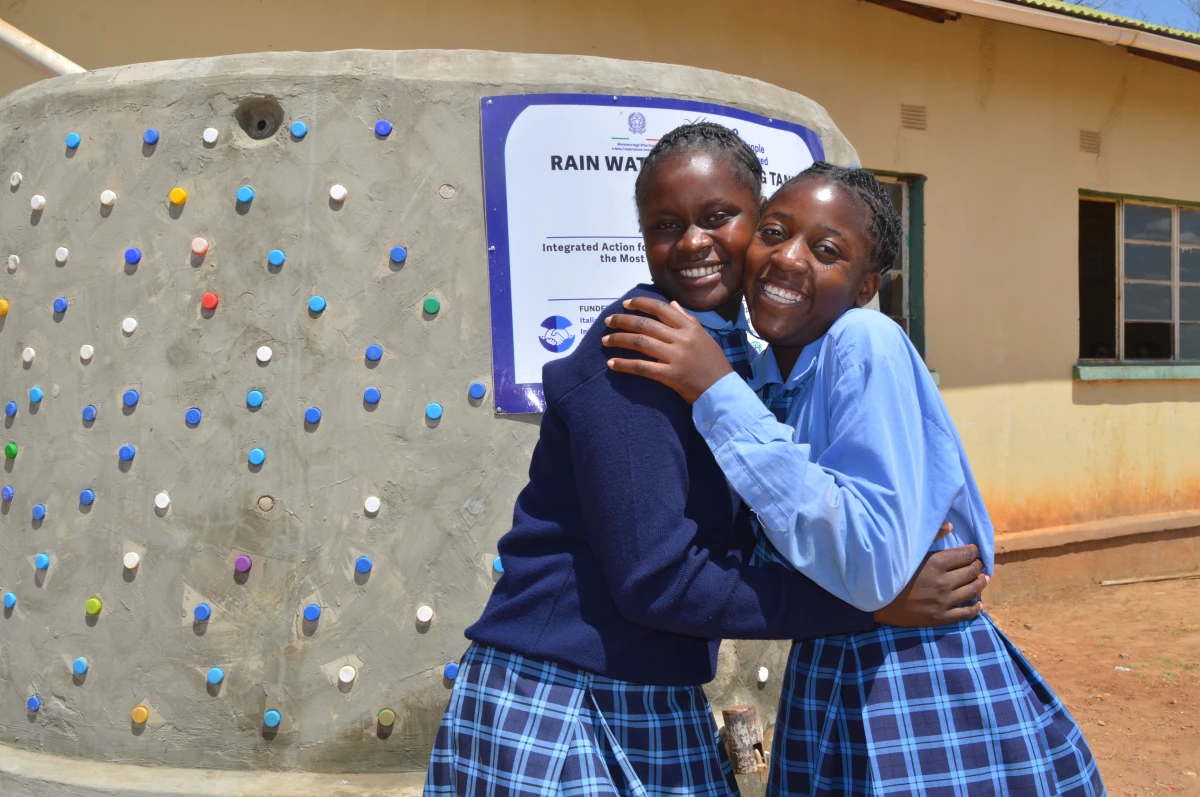
For students Mendra Hanzemba and Kaambo Mumba, water shortages meant leaving lessons to fetch water. At a school with 1,181 students, this disrupts learning throughout the day.
Collecting water often required two students to walk together to the borehole. This time-consuming task meant even more time was spent away from class.

Kaambo had a similar experience. Missing explanations and classroom instructions made it harder for her to fully participate in lessons and keep pace with her classmates. Her experiences reflect how limited water access can affect sanitation, hygiene, and the overall learning environment.
Tackling the Challenge
Moobola Day Secondary School has 1,181 pupils (584 boys and 597 girls) and 27 teachers. For a long time, they have all shared limited and unreliable water sources.
Through the AIM Zambia (Integrated Action for Mitigating the Effects of Climate Change on the Most Vulnerable Communities in Zambia) project, we constructed a rainwater harvesting tank at the school in April 2026.
The 2,500-litre rainwater harvesting tank was built using recycled 500ml plastic bottles, providing an innovative response to the school's ongoing water challenges. The system captures rainwater from the roof through a guttering network and stores it for use throughout the year. The tank can be replenished through an inlet using a hosepipe connected to the clinic’s tap if rainwater—or water from other sources—is unavailable.
The tank allows the school to store water for sanitation, hygiene, and school activities when the clinic’s supply is switched off, and the water is treated with chlorine to make it safe to drink. The amount of water available depends on rainfall, storage, and opportunities to replenish.
Before the tank was installed, the school relied on a borehole about 400 metres from the classrooms and a tap connected to the nearby clinic. The clinic managed its own distribution schedule, so water was not always available when learners needed it.
Although 400 metres may seem like a short distance, the time to walk there and wait for water is time away from lessons. If the school water point is unavailable, learners have to walk to the borehole, and wait their turn before returning to class.

Dignity at School
Although the structure of the new water tank is simple, its benefits extend beyond water storage. The stored water supports handwashing stations, classroom cleaning, maintenance of ablutions, cooking, and botany. It is also expected to support planned school gardening activities.
For the 597 girls at Moobola, water is central in managing their menstrual cycle. Having water available at school can make it easier to wash during menstruation. Simply put, managing a period at school takes water and a private place to wash.

Her experience highlights the connection between water access, dignity, and education. Reliable water access helps girls manage their needs during the school day and reduces interruptions to their learning.
Practical opportunities for learning
The water tank has opened doors in the classroom. Moobola’s curriculum includes an agriculture studies programme, but practical learning was a challenge without a dependable water source.

Through the garden, students will apply classroom knowledge and explore the role of water management and agriculture. It will also help them understand how agricultural practices can adapt to changing climate conditions.
Preparing for tomorrow
Across Zambia, communities face changing rainfall patterns and longer periods of water stress. The Zambia Meteorological Department forecasts early rains followed by a dry spell during parts of the season, creating uncertainty for farmers and communities.
Whilst the tank cannot eliminate water stress shortages, it gives the school a way to collect and store water when supplies are available. Consequently, it’s effectiveness during dry periods will depend on the amount of water collected and the opportunities to replenish it.
For Mendra and Kaambo, more accessible water means more time for lessons and better access to essential school facilities. For the wider school community, the tank supports hygiene, sanitation and practical learning.
At Moobola Day Secondary School, rainwater harvesting is helping create the conditions for dignity, learning, and climate resilience for current and future generations of learners.
AIM Zambia project Snapshot: Building Climate Resilience in Southern Province and Western Province.
Through the AIM Zambia project, we and our consortium partners are working to improve water access, strengthen hygiene practices and support climate-resilient agriculture across Southern and Western provinces.

Water access and infrastructure
• Installed three 2,500-litre UV-treated rainwater harvesting tanks at St Margaret's Primary School in Moobola Ward, Mikata Rural Health Centre, and Nakalombwe Rural Health Post.
• Installed three 2,500-litre UV-treated rainwater harvesting tanks at Mbambe and Sikushi Primary Schools in Sikongo district and Keyana and Sebumbu Primary in Shangombo district in Western Province.
• Constructed a 2,500-litre rainwater harvesting tank using recycled plastic bottles at Moobola Day Secondary School
• Completed handpump rehabilitation works at Tuenke and Yumba Yafumu water points in Moobola Ward, Namwala District, and at Mwili Primary School in Mikata Ward, Kalomo District.
Climate-resilient agriculture and food security
• Trained 16 Ministry of Agriculture staff through Training of Trainers (ToT) programmes on Climate Smart Agriculture, Post-Harvest Management, and the production of maize, cowpeas, and vegetables in Southern and Western provinces.
• Trained 400 farmers in Namwala and Kalomo districts in Climate Smart Agriculture, to help strengthen food security and adapt to changing climate conditions.
• Distributed seeds, organic fertiliser, and farming tools, to 400 vulnerable households, supporting climate-resilient agricultural production.
• Supported the construction of 34 household silos in Namwala and Kalomo districts in Southern Province and 16 in Shangombo District in Western Province to help store food and reduce post-harvest losses.
Water, sanitation and hygiene (WASH)
• Trained 240 participants in WASH, including 40 health workers and 200 community-based volunteers (CBVs), across Malambo Ward in Sikongo District, Mikata Ward in Kalomo District, Shangombo District and Moobola Ward in Namwala District.
• Distributed 300 menstrual kits to female learners in April 2026 at Moobola Primary School and Chuulu Chikunka School in Namwala District; Mikata Primary School and Mikata Secondary School in Kalomo District; Mabuwa Primary School and Sikushi Secondary School in Sikongo District; and Keyana Primary School in Shangombo District. Each kit contained five reusable sanitary pads.
• Provided community awareness to 68,135 people in Moobola Ward in Namwala District, Mikata Ward in Kalomo District, Keyana in Shangombo District and Malambo in Sikongo District. The campaigns were facilitated by 80 trained CBVs, who supported community mobilisation and hygiene promotion.
About the project
The AIM Zambia project is funded by the Italian Agency for Development Cooperation (AICS) through the Ministry of Foreign Affairs and International Cooperation (MAECI).
The project is implemented by CELIM in partnership with People in Need Zambia, Keepers Zambia Foundation (KZF), Christian Blind Mission (CBM), Africa Call Zambia, and Adventist Development and Relief Agency Zambia (ADRA).


