
Strengthening Syrian families’ resilience through cash-based interventions
Published: Feb 17, 2026 Reading time: 4 minutes Share: Share an articleAfter nearly 14 years of war, Syria found a semblance of peace in 2024. However, humanitarian needs remain acute. Fourteen years of war devastated Syria’s economy. According to the World Bank, extreme poverty now affects one in four Syrians, while two-thirds live below the lower-middle-income poverty line.
The UNDP reports that three out of four people (16.5 million) depend on humanitarian aid and need development support in areas such as health, education, income poverty, unemployment, food insecurity, water and sanitation, energy, and housing. Additionally, the destruction of public infrastructure has significantly intensified the impact of the conflict.
Over a million people still live in camps in Syria
Although many displaced families have returned, they often come back to homes that are damaged or destroyed and to communities with limited access to services and livelihood opportunities.

An estimated 5.1 million people remain internally displaced in Syria, including 1.3 million living in 1,531 IDP sites and camps in the north-west and north-east of the country. As a result, communities will continue to rely on humanitarian assistance to meet their needs.
Freedom of choice and support for the local economy
Given the dire socio-economic situation, and with funding from the European Union, we focus not only on supporting formal and informal education in Syria but also on support with winterization and food security. By working with local communities, we help strengthen families’ resilience, giving them freedom of choice while also supporting the local economy across northern Syria through cash-based interventions.
“We provided families with winterisation cash assistance to help them overcome the lean winter season and cover basic winter needs. At the same time, we provided the most vulnerable people with six monthly-rounds of cash to help them meet their needs. We also delivered several rounds of food vouchers to families that needed it most,” says Martina El-Haddad, People in Need’s Grants and Programme Development Manager.
This type of support has helped tens of thousands of families. “We are a family of eight, and our situation is difficult because there is no work,” says Hasan Qasem. With funding from the European Union, we supported families in 19 villages in the rural areas of the Aleppo and Idlib governorates.
“The support centres on electronic food vouchers loaded with $100 and distributed over six rounds. Through the voucher, people can buy food and cleaning supplies. Vouchers are redeemed through authorised suppliers accredited by People in Need across the selected villages,” explains Mohammad Al-Dali from People in Need.
“We can buy vegetables, rice, ghee, and oil—everyday staples. It helps, as the $100 supports families to some extent,” says Hasan Qasem.
Six months of support via e-cards
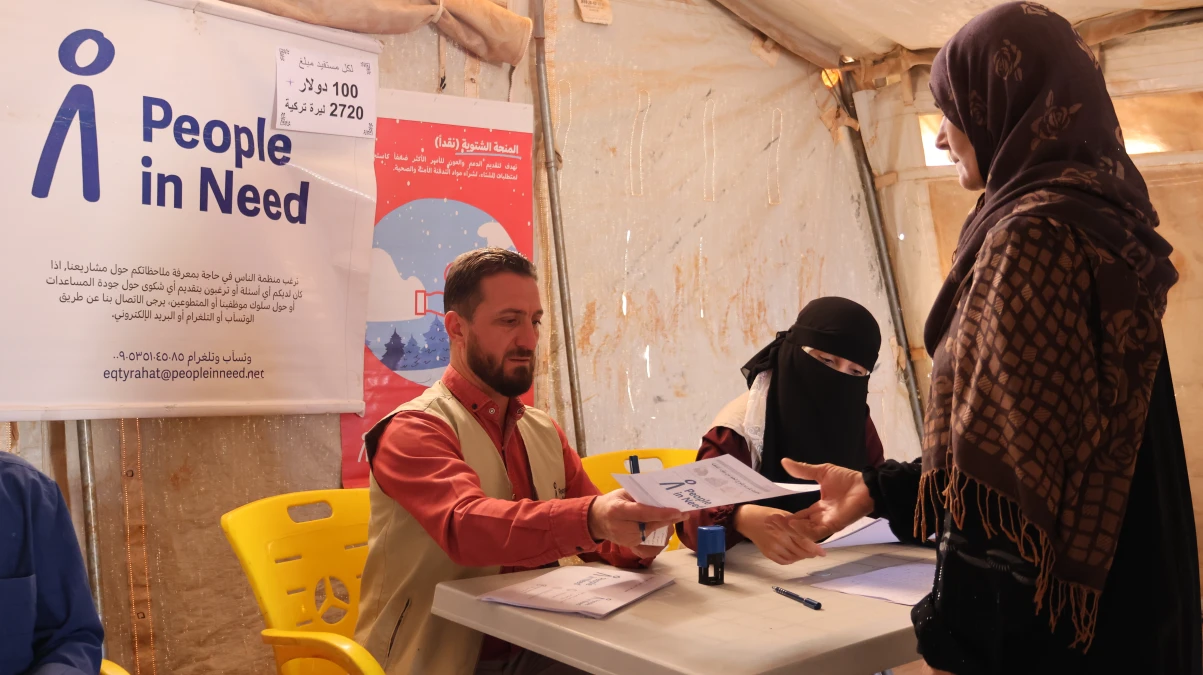
Cash assistance is another form of support we provide. To ensure that this gets where it is needed, we conducted door-to-door registration of the most vulnerable families, including female-headed households, child-headed households, elderly people, chronically ill or disabled individuals, families living in unfinished or damaged buildings or tents, large families with more than six members and no provider, and families that had not received similar assistance.

Selected families received $100 in monthly cash assistance over six rounds via distributed e-cards. “The distribution of the cards took place in the first month, while the remaining rounds were provided through remote top-ups. The advantages of the e-cards are not limited to ease of use and cost efficiency, but also include environmental considerations, as the card is multi-use and recyclable,” explains Martina El-Haddad.
The contracted shops where people could use the e-cards were located within the selected communities and offered food, non-food items, and cash back. All contracted shops displayed banners indicating their participation in the e-card programme, and prices were posted in stores. Our team encouraged vendors to source food from local farmers and producers, promoting local sourcing and reducing food imports.
Surviving the winter cold
Additional support was provided through one-time winterisation cash assistance to people living in camps, informal settlements, and hard-to-reach locations, enabling them to purchase essential winter items, including fuel, clothing, or other necessities.
During information sessions, we highlighted potential environmental and health risks associated with unsafe heating practices. People received brochures on selecting high-quality heating materials, avoiding harmful substances such as plastics or old clothing, and ensuring proper ventilation when using fuel.

“Distributions took place in October and November 2024, ensuring households were adequately prepared for winter. Each family received $180. During post-distribution monitoring, 83% of people reported significantly improved living conditions due to the assistance, while 17% indicated moderate improvements,” says Martina El-Haddad.
Most households (96%) used heaters burning firewood, charcoal, or olive-pit biomass, while smaller proportions used nutshells, fuel-based heaters, reused materials, or electric heaters. Additionally, 4% improved insulation and 12% purchased winter clothing. This helped more than 5,000 families survive the winter cold.
EU support to Syria
Together with its Member States, the European Union is the largest donor to the Syria crisis. EU humanitarian addresses urgent, life-saving needs while also paving the way to early recovery by improving access to essential services for vulnerable populations.


