
Cash Assistance: Relief and hope for families in northern and central Afghanistan
Published: Jan 21, 2026 Reading time: 3 minutes Share: Share an articleOmarkhail is a small village in central Afghanistan, where small mud-brick houses tell a story of poverty, resilience, and survival. For years, families here have endured conflict, natural disasters, and worsening climate-related shocks.
Mohammad Naem (43) lives in Omarkhail with his five children—three sons and two daughters. He is his family’s sole provider. “My two daughters go to CBE classes, and my son studies at a madrasa,” he says. “Finding work is hard, especially in winter. Without daily work, how can I afford even to pay for our needs?”
“Winter makes everything harder, and with the closure of the borders with Pakistan, food prices have gone up. As have heating costs. With all these shortages, how can I pay for my wife’s treatment? I often must choose between food, warmth, and medicine. Sometimes, I feel life has been too hard on me,” he tells us.
He is not alone. According to OCHA, 21.9 million people—almost 45 percent of Afghanistan’s population—will need humanitarian assistance in 2026. Economic challenges, displacement, and climate shocks push families further into hardship, leaving millions unable to afford enough food to eat.
Cash: relief for over 10,000 people from 150 villages
To address some of these urgent needs, we provided cash to 1,423 families (10,334 people) across 150 villages in Nerkh, Dara e Suf Bala, and Dara e Suf Payen districts of northern (Samangan) and central (Maidan Wardak) Afghanistan.

Funded by the European Union (EU) and co-funded by the Ministry of Foreign Affairs of the Czech Republic (Czech Development Cooperation) , the cash gave families the freedom to decide how to prioritise their needs. Some bought food, others medicine, firewood, or warm clothes. “The help came at the right time,” says Mohammad Naem. “It made a real difference for my family.”
Mohammad Naem never went to school and works as a daily labourer whenever work is available. “I cannot read or write, and I do not want my children to face the same hardships in life. I want them to study and, inshallah, become doctors, teachers, or engineers,” he says.

Mohammad often travels to Kabul, Ghazni, or Logar to find work, sometimes staying away for months and often returning with little or no income. “Today, I received 29,620 AFN (about $450),” he says after the distribution. “I will buy wheat, oil, beans, and firewood. I will buy warm clothes for my children. I will also pay for part of my wife’s treatment,” he adds.
Education: an investment in the future
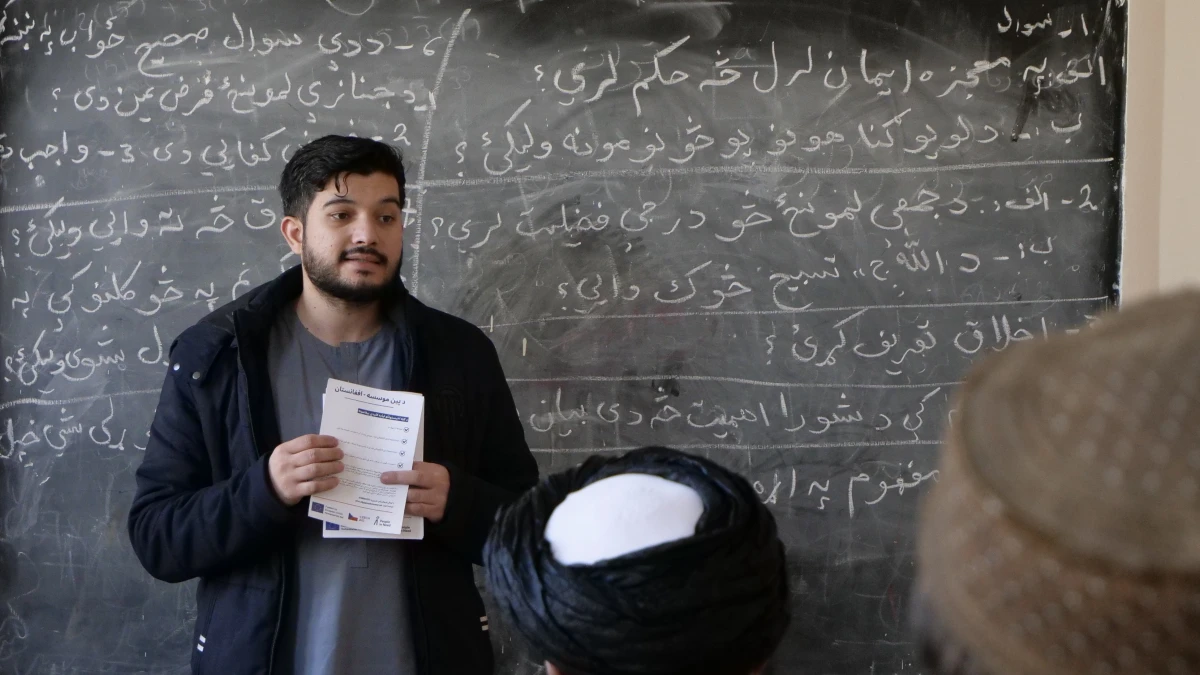
With funding from the European Union, and in partnership with the local organization SADA, we established Community-Based Education (CBE) classes in this village. These classes bringing hope to children. “If these classes were not here, my daughters would stay at home,” he says. “Now they go to school every day. They are happy. They have hope. Without education, a person is blind, and I do not want my children to live in the dark,” he adds.


For families like Mohammad Naem’s, this support is more than just meeting urgent needs. It gives parents a chance to rest, feed their children, keep them warm. It allows them make choices for their families, prioritise their needs and protect their dignity. “Tonight, my family will eat better,” he says softly. “We will pray for everyone who helped us.”
When families are supported and children can go to school, life feels a little easier, and tomorrow seems brighter.


