
A Safer Road to Learning: How a Community United to Protect Its Children
Published: Dec 11, 2025 Reading time: 2 minutes Share: Share an articleEvery morning in Kawergosk camp, hundreds of children stepped out of their tents and toward a danger they could not avoid. Between them and their school lay a busy main road, fast cars, no speed bumps, and no protection. Each crossing felt like a silent gamble.
For years, parents feared the worst. “The risk of accidents was always at its peak,” said Nafia, 51, mother, camp resident, and the head of the Parent-Teacher Association (PTA). Since 2014, she has dedicated her life to supporting education in the camp, filling gaps that no institution had stepped forward to solve.
“At the beginning, the Ministry and organisations couldn't respond to all the needs,” Nafia recalled. The school struggled with unsafe access, limited water and electricity, and a shortage of teaching materials. But the greatest threat was the road. Every child walking to Jgarkhwen Secondary School had to cross the same fast, uncontrolled road. “The most unsafe thing was that road,” said Elaf, a 17-year-old student. “Cars were driving fast, and we were always scared something could happen.”
Though no major accident was officially recorded, the danger was constant. “We felt the risk every day,” added Hunar, a traffic police officer who worked closely with the school. “The students had no protection.”
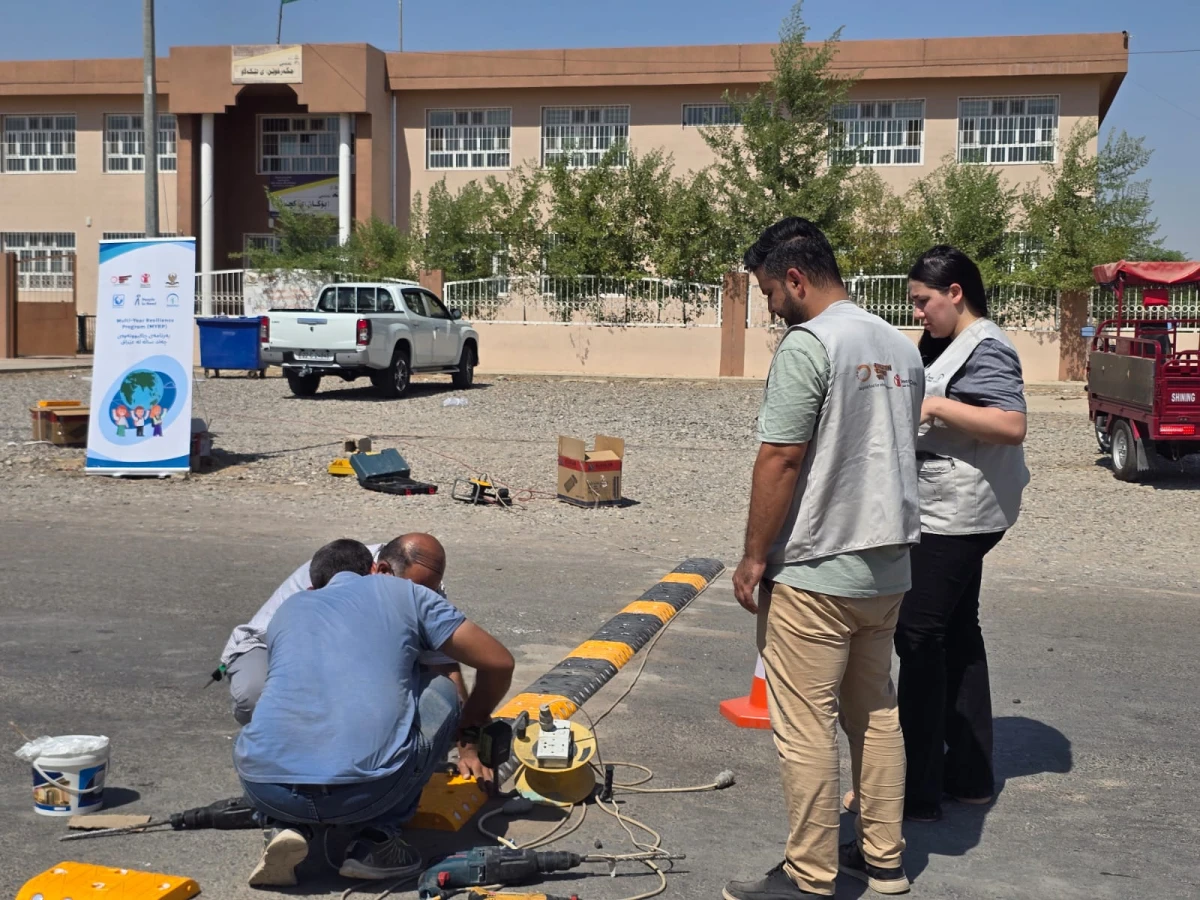
To help the students to have a safe road to their school with the fund from Education Cannot Wait (ECW) and partnership with Save the children, Intersos and Rwanga foundation, as well as the PTA and the school administration, camp management, the municipality, and the traffic police we coordinated a long-overdue solution: installing two speed bumps in front of the school. It was a small intervention with a life-changing impact.
Once the speed bumps were installed, the transformation was immediate. Cars slowed down. Students crossed with confidence. Parents breathed again. “There is a big difference between the past and the present,” said Nafia. “With the speed bumps, we were able to save more than 500 students from accidents.” For Elaf, the change meant more than safety; it meant freedom.
The strength of this achievement lies not only in the speed bumps themselves, but in the unity behind them: the PTA, local authorities, traffic police, the municipality, teachers, camp leadership, and PIN all worked hand in hand. “I feel comfortable and confident because I left a mark of hope on the students’ faces,” Nafia said with pride. “I fulfilled my duty as a mother.”
The project didn’t stop at road safety. PIN supported the school with remedial classes, awareness sessions, and learning activities, efforts that helped students grow despite the challenges of displacement.


