
Community Champions reviving coffee farming in Basilan and Sulu
Published: May 26, 2026 Reading time: 5 minutes Share: Share an articleOn the islands of Basilan and Sulu, coffee was a quiet casualty of conflict. Farms were abandoned, trees left untended, and farmers gradually lost both income and confidence in the crop that once sustained many communities. Years of instability, poor market access, low buying prices, and limited technical know-how further pushed coffee production into decline.
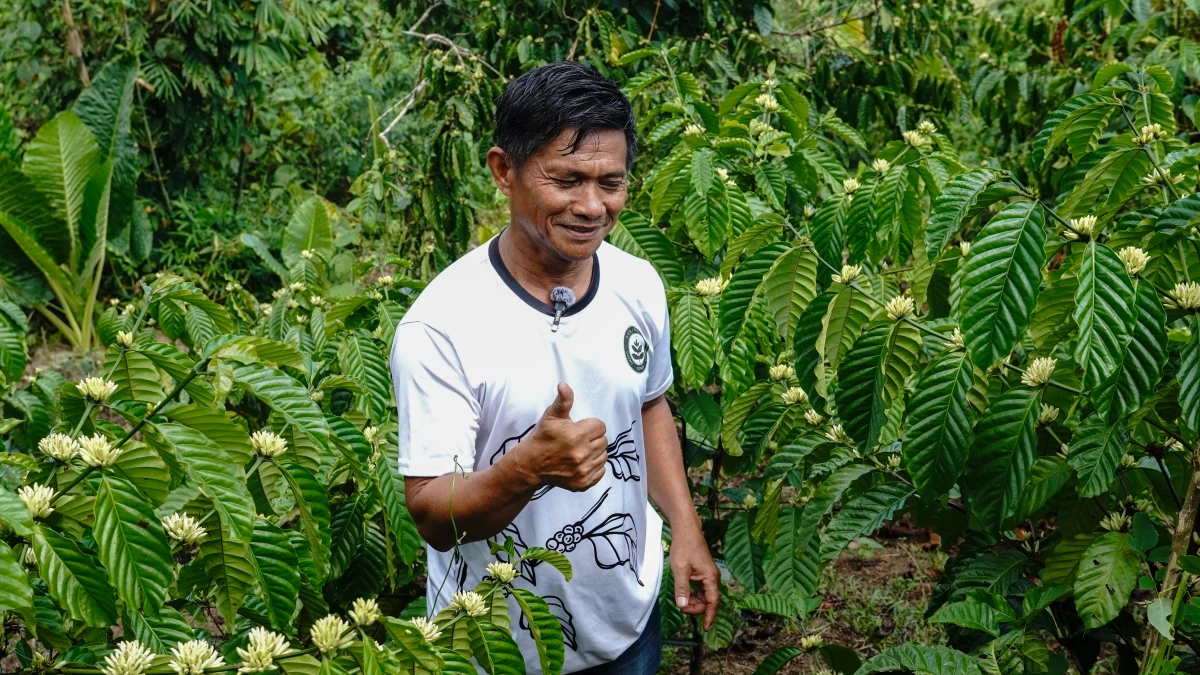
Yet amid the decline, community leaders remained among a stabilising presence within the farming communities. Ibrahim Uto, 68, from Basilan, and Ajahuli Ahajani, 55, from Sulu, witnessed the collapse of coffee farming firsthand. Today, they are leading efforts to revive coffee production in their communities, combining renewed agricultural support with local leadership to restore livelihoods and rebuild trust in farming once again.
Sustaining efforts amid decline
In Basilan, Uto serves as Chairperson of the Lamitan Agrarian Reform Beneficiaries Cooperative (LARBECO). He recalls how the cooperative was forced to move away from coffee production in the early 2000s after farmers could no longer sustain income from the crop. Around 100 hectares of coffee farms were eventually converted into coconut plantations.

In Sulu, coffee had long been part of daily life, but years of neglect and instability weakened farming systems. Trees were left unmanaged, while cultivation practices were reduced mainly to harvest periods.

From the 1970s onward, recurring instability across Basilan and Sulu disrupted mobility, limited access to markets and information, and prevented many farmers from learning improved farming practices. Over time, confidence in coffee production steadily eroded.

For both leaders, the challenge eventually became larger than restoring coffee production itself. It meant rebuilding trust among farmers who had spent years seeing little return from agriculture.
Support through local actors
In 2023, the Bangsamoro Agri-Enterprise Programme (BAEP) launched a four-year, EUR 20 million or over PHP 1.2 billion initiative funded by the European Union to strengthen agribusiness and livelihoods across BARMM. Through the Leveraging and Expanding Agri-Aqua Production in Bangsamoro (LEAP) initiative, implemented by People in Need Philippines, Maranao People Development Center Inc., and United Youth of the Philippines - Women, Incorporated, organised coffee clusters in Basilan and Sulu, received support to rehabilitate farms, and rebuild the local coffee and seaweed value chain.
That same year, LEAP conducted a Market Assessment and Value Chain Analysis for Coffee in Basilan and Sulu to inform project strategies and interventions. The study found that the coffee industry in both provinces faces challenges across the entire value chain. From input supply, farm management, harvesting, and drying practices, to limited access to modern farming and processing technologies, financing, certifications, packaging and labelling, and market opportunities. It also identified gaps in the participation of marginalised sectors, data and information management, research and development, as well as individual and organisational capacities.

Based on the findings, LEAP provided farm rehabilitation support, technical training, and shared facilities to improve production and product quality. Farmers took part in practical training on land preparation, rejuvenation techniques, harvesting, post-harvest handling, quality assessment, and market orientation. They were also given post-harvest equipment and facilities to support processing and improve efficiency.
Still, reviving coffee farming in these islands required more than technical interventions. Farmers needed to see that the methods worked before fully embracing change. Uto and Ahajani understood this early on, choosing to apply the new techniques first on their own farms.

Uto planted around 500 Robusta, Excelsa, and Liberica coffee trees on his land, while Ahajani rejuvenated and established around 700 trees using the same varieties suited to local conditions. Within ten months, fellow farmers saw Ahajani’s rejuvenated coffee trees flower once again.
Drawing from exposure visits in Bukidnon and Davao, Uto expanded his efforts beyond his own farm. He encouraged both cooperative and non-cooperative members to return to coffee cultivation and adopt improved farming practices. He advocates for the use of remaining cooperative funds to invest in additional coffee seedlings and farm expansion.

The changes are gradually translating into economic gains for farming communities. In Kabbon Takas, coffee sold through the association now reaches PHP 250 to 300 per kilo, compared to PHP 100 to 150 previously. In Basilan, farmers are also beginning to diversify their income through complementary crops while waiting for coffee trees to mature.

Beyond income, the revival is also reshaping how communities are seen.
In these island communities, recovery is gaining momentum not only through external support, but through champions willing to lead by example and make change visible to others. Slowly but steadily, coffee is once again becoming part of how communities rebuild livelihoods, restore stability, and regain confidence in their future.


