
Cultivating Sustainable Livelihoods: How we Tackle Unemployment in Ethiopia
Published: Aug 28, 2026 Reading time: 5 minutes Share: Share an articleMany women and young people in Ethiopia face structural barriers that hinder their ability to build resilient livelihoods. Through the EU-funded “EMPOWER” project, we are tackling systemic unemployment. By promoting greening initiatives, updating technical and vocational training (TVET), offering eco-friendly curricula, creating specialized training resources, and supplying necessary equipment, we address gender and social inclusion barriers. By combining private sector engagement with access to inclusive financial products, we support the creation of sustainable long-term solutions to escape poverty.
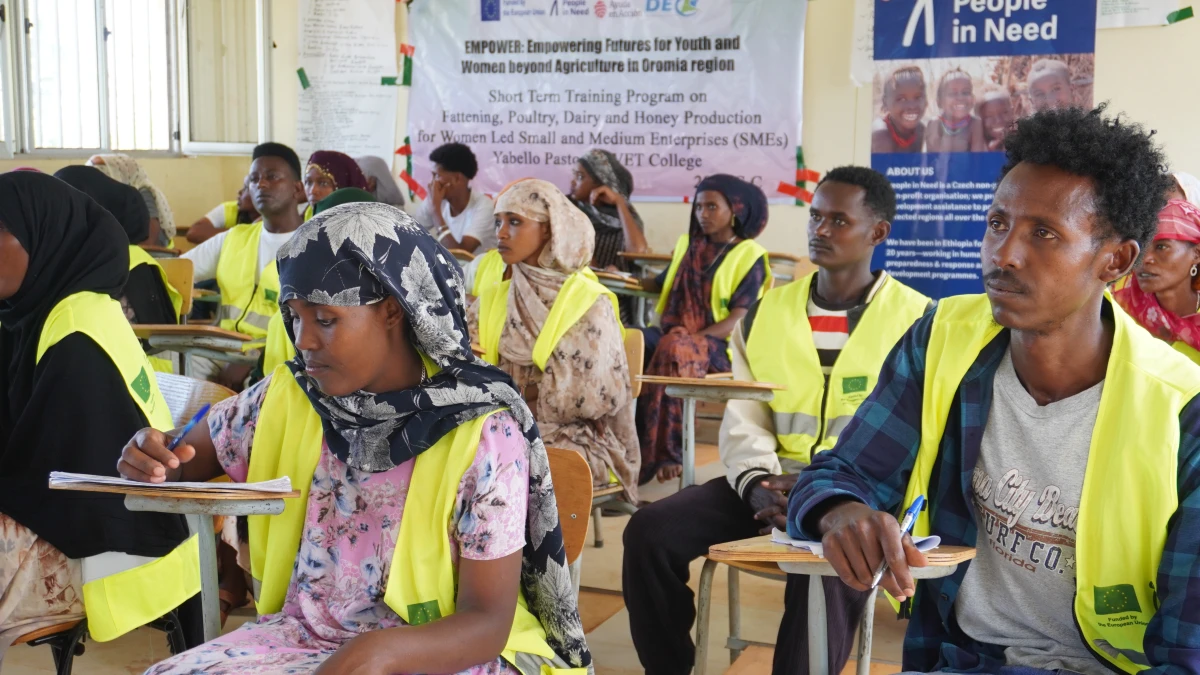
Qabballee Gadaa, a 24-year-old married mother of three, had never experienced formal employment before connecting with the EMPOWER project. This changed when she completed a specialised training programme in modern cattle fattening at the Yabello Pastoralist College.
This college is one of 11 partnering vocational institutions across three regions in Ethiopia. To turn her training into a sustainable livelihood, we supported Qabballee and her peers in establishing a small-scale livestock fattening business, providing them with initial seed livestock to jumpstart their enterprise and build long-term economic resilience.
"I gained great knowledge from the training. I learned how to fatten cattle and feed them properly," Qabballee shares. "Before this, when I wasn’t working, I didn't even have a house to live in. But now, since we got into this work, things have changed; I hope we can build a house with the money we earn from it. We have 10 head of cattle now, but we hope to grow to fifty or sixty, or even up to a hundred."
From traditional methods to modern ones
Similarly, college graduate Yitagesu Gezahegn (28) found himself unemployed. Through our training, he moved from inefficient, traditional feeding methods to modern, nutrient-dense feedlot practices that achieve weight gain much faster.
"As you can see, they bought and gave us ten cattle. You can see the transformation of these cattle within a short period since they arrived. You can see how many kilograms they have gained, and we will continue to benefit from them," explains Yitagesu.
Access to finance
Young people want practical, modern vocational training. Local steering committees, made up of local government authorities, community leaders, and representatives from government centres where unemployed youth are registered, select candidates. Eligible applicants are unemployed youth or women from structurally disadvantaged groups who lack the starting capital to establish their own enterprises.
“Crucially, candidates must demonstrate a strong commitment to engaging in one of the four prioritised high-potential, agricultural value chains in the Oromia region: honey production, poultry farming, dairy farming, and livestock fattening,” says Robe Kuti Gobana, PIN Project Manager.
Following selection and technical training, we facilitate critical linkages with commercial financial institutions.

For instance, the small and medium enterprise (SME) group formed by Qabballee and Yitagesu developed a viable business proposal and successfully secured a loan of ETB 750,000 (€4,095) from the Cooperative Bank of Oromia. To overcome conventional collateral barriers that typically exclude vulnerable youth and women, we provided a financial guarantee product to secure access to the loan.
To ensure the enterprise's long-term sustainability and environmental harmony, the group also received comprehensive financial literacy training alongside technical guidance on greening their production.
This approach integrates innovative, climate-resilient technologies such as solar-powered feed mixers, grinders, incubators, brooders, and refrigerators to build a clean, sustainable, and highly efficient agribusiness model for fattening, poultry honey, and dairy SMEs.
Modernising equipment
While the Yabello Pastoralist College previously offered training in agricultural value chains, the institution lacked the contemporary instructional frameworks and infrastructure necessary to deliver high-quality, practical education.
We supported them in co-designing an environmentally sustainable curriculum and donated approximately 300 pieces of specialised equipment, such as specialised mowers and compactors used to convert grass into long-lasting silage.

Shimelis Zenebe, an animal science trainer at the college, notes: “This machinery enables us to effectively fulfil our mandate of delivering 70% practical, hands-on training. Beyond enriching student education, the college leveraged this equipment to scale up its own commercial honey and poultry production, boost internal revenue generation, and ensure long-term institutional self-reliance.”
Next steps
One of our crowning achievements is the impact on community attitudes toward women's participation in economic life. At the beginning of the project, much fewer women applied than expected. Recognising this, we leveraged local community structures, partner organisations, and government channels to drive change.
Women now make up sixty per cent of all project participants in short-term vocational training. We have created a healthy, competitive environment where young women enthusiastically acquire technical skills, enter the workforce, and build financial independence.
Looking to the future, the emphasis is firmly on long-term sustainability and fostering community ownership. By shifting from manual, fragmented labour to organised, market-aware business units, the women and youth of Oromia are proving they can build commercial enterprises capable of scaling independently, generating local employment, and driving resilient economic growth across the region.
About the project:
EMPOWER: Empowering futures for women and youth beyond agriculture, funded by the European Union. People in Need, in partnership with Ayuda en Acción and the Development Expertise Centre (DEC), creates inclusive and environmentally friendly job opportunities across three Ethiopian regions. We support 11 vocational training centres to equip 4,500 women and young people with locally relevant skills. Additionally, the project aids and boosts the capacity of 80 small and medium enterprises.


