
Rooted in Resilience: Climate-smart innovations for Cambodia’s farmers
Published: Sep 14, 2026 Reading time: 5 minutes Share: Share an articleClimate change drives erratic weather and droughts, posing severe risks to agriculture. In Cambodia where agriculture contributes 22% to country’s gross domestic product and employs over 60% of the national workforce threats to this sector must be managed. To support Cambodians in this time of change, we produced a report that deep-dives potential practices to enhance Cambodia's climate resilience.
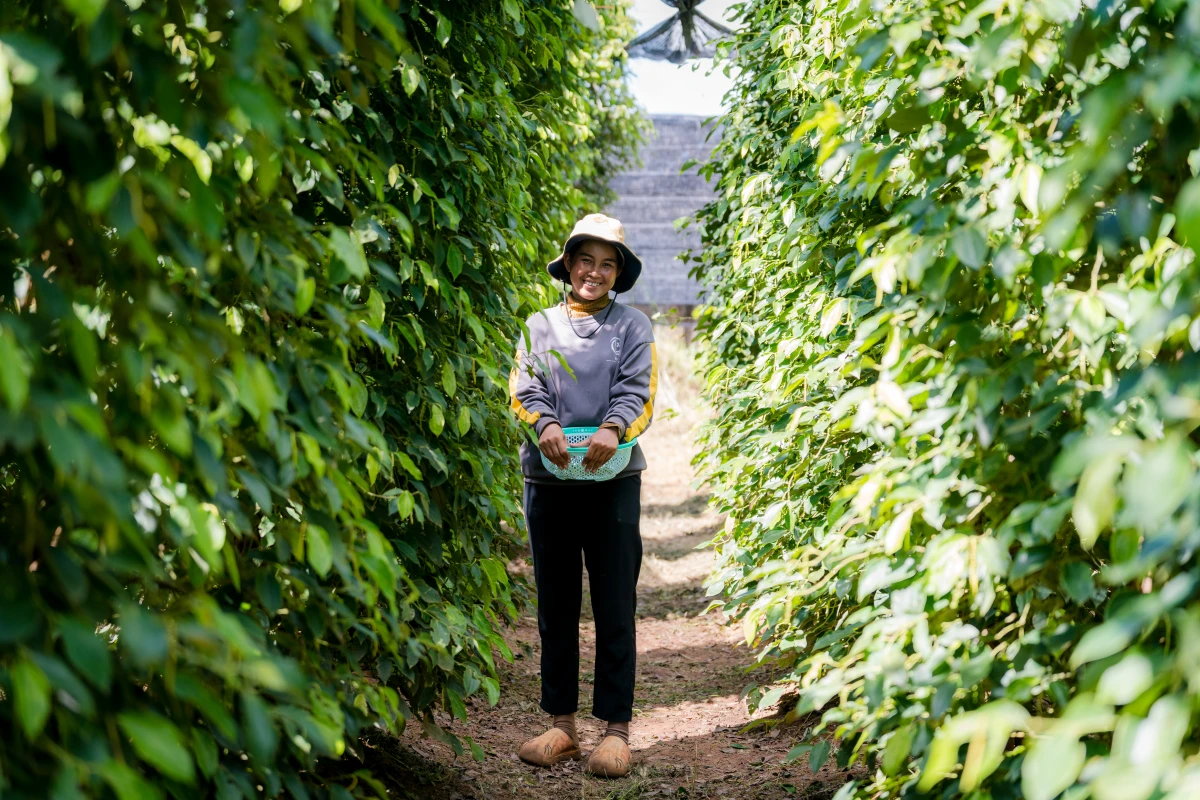
Cambodia is the world's largest raw cashew producer; however, limited domestic processing capacity causes significant economic loss. To address these challenges, our Greening Agriculture project evaluated and prioritised scalable climate-resilient agricultural practices to improve smallholder productivity, adaptability, and economic viability.
As part of their efforts the Greening Agriculture team produced a detailed report that assessed potential practices using environmental, economic, technical, social inclusion, and agroecological scalability criteria. Selected practices were restricted to budget limits under $5,000 per unit to fit smallholder financial resources. Researchers prioritised 15 key practices from 29 assessed interventions for cashew and pepper value chains.

Consultations demonstrated that farmers strongly prefer low-cost, low-complexity practices that use locally available organic inputs. Practices such as cover cropping and biochar application enhance soil organic matter, water retention, and yield stability under drought conditions. Solar-powered technologies reduce long-term operational fuel costs and emissions, though high upfront capital requirements hinder rapid independent farmer adoption. Land shortages and insufficient water access restrict individual establishment of cooperative-led seedling nurseries. Social inclusion assessments indicate women and youth can participate equitably in biofertiliser production, nursery care, and pest monitoring activities. Integrating these climate-smart practices strengthens smallholder farmers while fostering sustainable agricultural development.
Running from 2025 to 2028 under the EU-German CAPSAFE initiative, we partnered with GIZ and the Ministry of Agriculture, Forestry and Fisheries. Funding from the European Union and the German BMZ directly supports our work. As mentioned above, agriculture drives 22 per cent of Cambodia's GPD. The sector employs over 60 per cent of the national workforce. Consequently, high-value export commodities like cashew nuts and pepper are essential to rural livelihoods and the national economy. In fact, Cambodia produced nearly one million tonnes of raw cashew in 2024 across 580,117 hectares. This achievement made the country the world's top raw cashew producer by volume. Yet, local communities lose massive potential value because domestic processing remains extremely limited. Most raw harvests are sold across borders unprocessed. At the same time, unpredictable weather patterns and infertile sandy soils threaten crop yields while unseasonal rains ruin cashew blooms and heat stress degrades pepper vines.
Supporting communities and testing innovations
To help Cambodia farmers in their efforts to overcome these issues, our team works directly alongside local farming communities in 13 districts across Kratie, Kampong Thom, Tboung Khmum, and Kampot provinces. Kampong Thom alone holds 90,959 hectares of cashew fields, while Kratie accounts for 47,858 hectares.
We directly support over 22,000 smallholder cashew farmers and 38,000 value chain workers as they strive to build their futures. We also assist pepper growers, agricultural cooperatives, and local agri-enterprises. Gender and youth inclusion guide our operations. We focus on lowering female farm labour burdens while training young people to manage nurseries and green technologies—these practices ensure that our work is equitable and brings the maximum benefit to communities who need it.
To ensure our work was cutting edge, we evaluated 365 studies before screening 119 relevant agricultural practices. We scored each tool on sustainability, economic return, feasibility, social inclusion, and scalability. We set a maximum equipment investment threshold of $5,000 per unit. This price cap ensures local farmers can actually afford the technology. From 29 candidate options, we selected 15 top practices for active demonstration sites.
From practical tools to real impact
The results from our field evaluations have been deeply encouraging. For cashew systems, local biofertiliser production scored highest with a 4.83 rating out of 5. Producing five tonnes of compost costs around $500. It increases raw cashew yields from 0.88 tonnes up to 1.2 tonnes per hectare.
Cashew-legume intercropping scored 4.7 by supplying natural nitrogen and organic biomass. Integrating beekeeping into orchards scored 4.6. Managed beehives improve natural pollination, boosting yields by over 116 percent while generating extra honey income. Biochar applications and Stylo cover crops rebuild degraded sandy soils. Solar-powered irrigation systems eliminate fuel costs and slash farm carbon emissions. Meanwhile, pruning leader shoots increases nut yields by up to 24 per cent.
For pepper production, legume cover cropping achieved the top score of 4.8. In flood-prone zones, raised bed planting was shown to protect root systems. Solar drip irrigation and compost applications kept soil moist during severe dry spells. And solar drying domes accelerate post-harvest drying while keeping pepper clean from dust and contamination.

Living our agendas: Localisation, greening, and climate resilience
The Greening Agriculture project’s activities sit at the heart of our strategy as an organisation. Localisation shapes how we work. We empower local cooperatives to run decentralised seedling nurseries. Farmers create biofertilisers on site using crop residue, cutting reliance on expensive, often imported, chemicals.
Our greening agenda drives our shift away from synthetic inputs toward circular practices. Integrated Pest Management replaces toxic pesticides with sticky traps and biological controls to protect local biodiversity.
Finally, our climate agenda tackles both adaptation and mitigation. We promote drought-resilient cashew varieties like M-23 and tough pepper strains like Lampong. Biochar and cover crops store carbon directly in the ground; additionally, renewable solar pumps replace fossil-fuel engines, reducing carbon emissions across target regions. Through these practical efforts, we are building a more resilient, sustainable future for Cambodian agriculture.
Read the summary report here.
Read the full report here.


