
No one left behind: how civil society is shaping Mongolia’s digital future
Published: Jun 22, 2026 Reading time: 9 minutes Share: Share an articleMongolia is digitalising fast. But for older people in remote areas, herders on the steppe, people with visual impairments, and families on the margins of Ulaanbaatar, speed alone does not mean inclusion. The DICE project spent 30 months testing a different approach: working through civil society to make digital transformation real for the people it was missing.
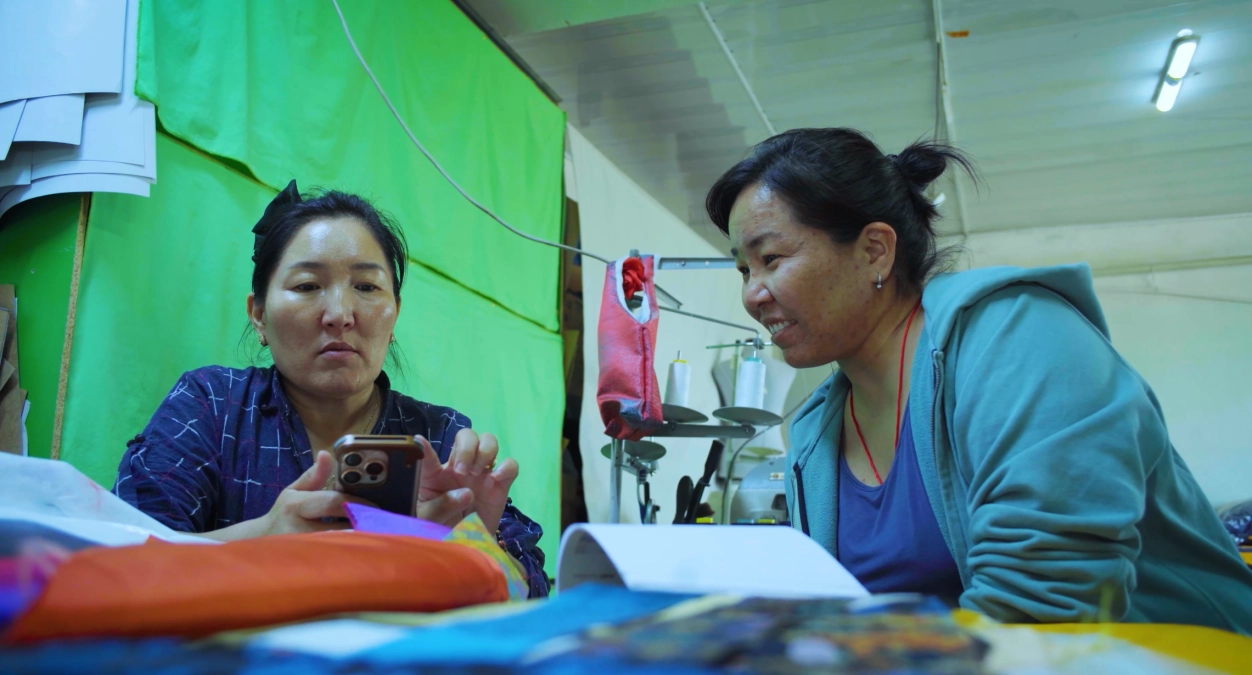
Mongolia has been moving fast in digital transition. Since 2020, the government’s Digital Nation strategy has pushed services online at speed, such as booking hospital appointments, renewing documents, and paying taxes. For city-dwellers with smartphones and stable internet, daily life has become simpler. But for elderly people with limited digital skills, herders on the steppe, people with visual impairments, and families living on the outskirt area of Ulaanbaatar city, the shift has often felt less like progress and more like being left further behind.
“People with visual impairments encounter many problems,” says Delgermaa Ch, Director of Development Assistance Centre, an organisation that has worked with visually impaired people for years. “Without digital skills, they lose personal information, fall victim to cybercrime, and cannot access public services or online banking independently.”
She describes a scene that was common before her organisation joined the DICE project. When a person with a visual impairment took a taxi, they had to hand their phone to the driver to process the payment. The driver could transfer any amount they chose. Passwords to e-Mongolia accounts, email, and Facebook were routinely shared with strangers, not out of carelessness, but because there was no other way to use the services. The dependency ran deeper than inconvenience.
From awareness to action
The Digital Inclusion through CSO Empowerment (DICE) project, implemented by People in Need (PIN) Mongolia and Faro Foundation with support from the Ministry of Digital Development, Innovation and Communications, and funded by the European Union delegation to Mongolia, set out to change this. Its approach was deliberate: rather than engaging communities directly, DICE worked through civil society organisations (CSOs) that were already trusted, embedded, and present in the places and among the people that Mongolia’s digital transformation was passing by.
Over 30 months, from December 2023 to May 2026, 65 CSOs participated in digital skills training and support activities across the peri-urban areas of Ulaanbaatar and Umnugovi Province. The training followed six modules aligned with Mongolia’s Digital Competence Framework for Citizens, covering foundational digital tools, cybersecurity, e-government services, content creation, digital collaboration, and AI applications. Participating organisations then designed and delivered their own projects, reaching the communities they knew best.

Reaching beyond the target
Delgermaa’s organisation had planned for 30 participants. By the end, 70 had come through the programme.
The training introduced participants to Be My Eyes, a global application that connects visually impaired people with sighted volunteers via live video, as well as AI tools including Google Gemini and ChatGPT, which can describe surroundings, read text aloud, and guide navigation by voice in Mongolian. For many participants, these tools opened something simple but significant: the ability to manage a payment, identify a product in a shop, or find their way on the street without depending on a stranger to handle their phone.
“There are 180 million visually impaired people in the world. Only one million use Be My Eyes. My goal was to help our community live independently. Now, they can use AI to describe what is around them, tell them which direction to walk. They don’t need to ask anyone for directions anymore.”— Delgermaa Ch, Director, Development Assistance Centre
In a different corner of Ulaanbaatar, Ariungeral B., Operations Manager at Kindergarten run within the Veloo Foundation, tells a different story with a familiar shape. Her organisation runs programmes for families living and working near the city’s main landfill site. Digital services had remained largely out of reach, partly due to limited digital skills, and partly due to a psychological barrier: the fear of making a mistake on a screen that nobody could help fix.
“We initially planned to include adults 18 and above. But their work schedules made attending consistently difficult. When children came along with parents, we included them. Children learn fast. They went home and taught their parents, and their neighbours. That ripple effect was more powerful than anything we had planned.”— Ariungeral B., Operations Manager, Kindergarten under Veloo Foundation
Some practical impacts of the training include participants booking medical appointments independently, obtaining official documents through e-Mongolia, and using mobile banking without assistance for the first time.

Putting it into practice: the sub-grant programme
Training alone does not change much if it stops at the classroom door. The sub-grant component of DICE was designed around that reality. After completing their training, 29 of the 65 participating CSOs applied for and received grants to design and deliver their own digital literacy and advocacy, policy discussion programmes. In total, approximately €115,000 was disbursed across two rounds: one for CSO-led digital skills activities for citizens, and a second for policy and advocacy work.
The projects that came out of this process were as varied as the communities they served. In Umnugovi province, Khundlel Bakharkhal ran training across three soums, targeting herders and rural women. "If even one woman solves a problem she thought she could not, that is a success for me," said E. Uuganbyamba, the organisation's founder. One herder who had previously relied on family members to navigate government services now uses e-Mongolia — the application consolidates over 1,200 public services from more than 80 government agencies — independently. A participant who had kept her bank password taped to the back of her phone left with a much safer approach.
In the same province, Aspire for Sustainable Development l focused on female entrepreneurs, offering training on business automation tools, electronic procurement systems, and accounting platforms. "We did not just introduce tools," said Ts. Adyasuren, the organisation's executive director. "We showed how to use them in daily operations." Several participants went on to secure business contracts or win public tenders for the first time after the training.
The sub-grant mechanism was not just a funding channel. It was where the project's theory of change played out in practice. CSOs designed activities rooted in their communities' actual needs, adapted when plans met reality, and built local networks of people who could support each other after training ended. In several cases, participant groups formed their own online communities to continue sharing knowledge. In at least one instance, a CSO used its DICE experience to secure additional funding from another donor entirely, extending the work independently.
That multiplier effect, from training to action to new capacity to continued activity, is what the sub-grant model was designed to produce.

What the numbers show
Across all DICE small projects, 1,830 people were reached in total, the majority from groups who had had the least access to Mongolia’s digitalisation gains: older people, people with disabilities, rural women, and herders in remote provinces.
An independent evaluation completed in 2026 scored the project at 4.12 out of 5, with the CSO capacity-strengthening component rated 4.33, and described as “excellent.” Close to 82 per cent of participants reported that their digital skills had improved meaningfully. The share of organisations using digital tools in their work, communicating digitally with the public, and participating in policy dialogue increased by between 43 and 47 per cent over the project period.
In Umnugovi province, one CSO reported that the number of followers on its Facebook page grew from around 1,000 to between 3,000 and 4,000 after attending content creation training.

A foundation for policy change
Beyond community-level impact, DICE worked at a systemic level. Alongside training and small grants projects, participating CSOs contributed to the development of the Inclusive Digitalisation Advocacy (IDA) Roadmap, a strategic document that outlines how Mongolia’s legal and regulatory framework can better incorporate civil society in its digital transition.
“This is not just about technological solutions. It is a story of creating a democratic space that simplifies lives, brings society together, and truly ensures no one is left behind.”
— Chimegsaikhan M., DICE Project Manager, PIN Mongolia
At the project’s closing event in May 2026, the European Union delegation echoed that framing. “Mongolia, in pursuing its goal of becoming a Digital Nation, must leave no one behind,” said Adrien Murg, Head of Cooperation at the EU Delegation to Mongolia.

What comes next
The project’s closure does not mark the end of what it started. Several participating CSOs have already secured additional funding to continue their digital literacy activities independently. The Nutag Action Research Training Centre has been developing a mobile application specifically designed for herders, drawing directly on what it learned through DICE to build tools for people in Mongolia’s most remote areas.
The independent evaluation also identified clear gaps to address in future work: older participants benefit from more tailored and repeated training, smaller rural organisations need longer-term institutional support, and the IDA Roadmap needs clearer pathways from document to implementation. These are important findings that clearly point to what the next phase of work needs to include, in order to really ensure that no one is left behind in Mongolia.
What DICE demonstrated over 30 months, across 65 organisations and more than 1,800 people, is that digital inclusion is not primarily a technology problem. It is a question of which communities are counted in a country’s sense of progress, and which are not. Civil society, with the right support and resources, can help close that distance.
"What we saw through DICE is that strong civil society organisations are the bridge between Mongolia's digital ambitions and the people those ambitions need to reach. Training organisations is one part of the work. But what made this project different was watching those organisations take what they had learned and design something real for their own communities. A herder using e-government services independently for the first time, an older woman no longer having to hand her phone to a stranger to complete a bank transfer. These are not small changes. They reflect what inclusive digital transformation can actually look like in practice."
— Tricia Turbold, Country Director, PIN Mongolia
The DICE project was funded by the European Union and implemented by People in Need Mongolia and Faro Foundation, with support from the Ministry of Digital Development, Innovation and Communications of Mongolia.


