
Between coffee and harvest, women carry the wait
Published: May 29, 2026 Reading time: 4 minutes Share: Share an articleWalking through Norsida Jalalang’s two-hectare farm, flowering coffee trees rise in rows across a landscape threaded with vegetables and fruit trees. Cucumber vines climb beside coffee seedlings, while okra, squash, bitter gourd, and eggplant fill the gaps in between. The harvest is both enough to sustain her household and to be shared with neighbours and relatives in the community.
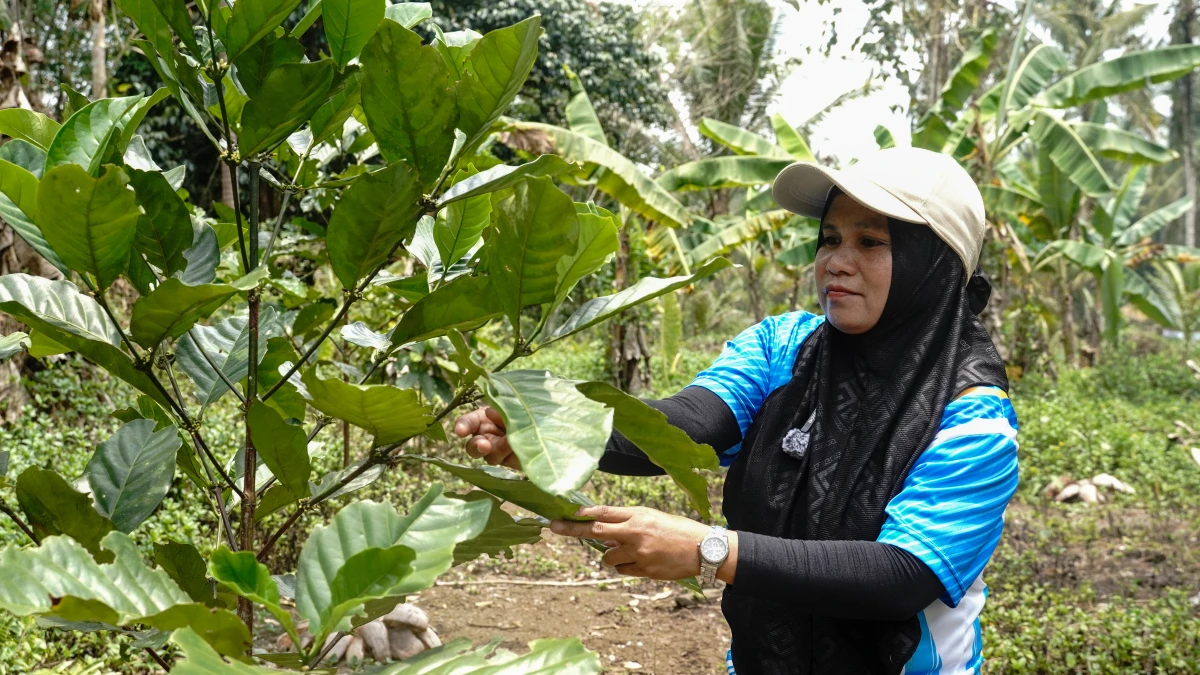
For Norsida, farming has long shaped her routines, rooted in vegetable production on land inherited from her parents, once intended mainly for household consumption. Coffee, however, is new to this system. Until recently, it had remained more of a childhood memory.
In 2023, she became one of the producers in Basilan supported under the Bangsamoro Agri-Enterprise Programme – Leveraging and Expanding Agri-Aqua Production in Bangsamoro (BAEP-LEAP) funded by the European Union. Through the project implemented by People in Need Philippines, Maranao People Development Center Inc., and United Youth of the Philippines - Women, Incorporated, Norsida received training to improve the coffee value chain in Basilan. The training included good agricultural practices (GAP), post-harvest handling, storage, and marketing.
But coffee requires time. With trees taking three to four years to bear their first fruit , production alone cannot sustain day-to-day needs. In this gap between planting and harvest, something else has to carry the household.

Before coffee returned
In Basilan, coffee farming has declined since the 1990s, largely due to the conversion of agricultural land and the prioritisation of rubber and coconut as dominant cash crops.
Norsida recalls memories from her early years, when harvest meant joining her elders and playfully climbing coffee trees to pick cherries. Over time, most families moved away from farming, leaving only a few older farmers to continue the practice.
While coffee production faded, Norsida’s experience remained anchored in vegetables. Through BAEP-LEAP, she re-entered coffee farming, this time alongside intercropping systems that allowed food crops to grow within her coffee fields.
Sustaining the harvest waiting period
Norsida has planted 126 coffee trees and gradually transformed her backyard garden into a diversified farm where vegetables and coffee now grow side by side. With seedlings provided by LEAP to promote intercropping, she cultivates cucumber, okra, squash, bitter gourd, and aubergine, which form the backbone of her daily production. Most are sold, while some are kept for household consumption.

The vegetables generate a steady income of around Php 300 to 500 weekly, sometimes exceeding Php 1,000. This helps cover food, school needs, and daily household expenses. In practice, vegetables sustain the family during the time coffee takes to mature.
Women and the growing coffee landscape
Alongside her vegetable harvests and the early flowering of her coffee trees after just over a year of applying good agricultural practices, Norsida’s role in the community has also grown.
She now serves as a coffee cluster leader in Bohe-Ibu, where more women are joining farming discussions, training sessions, and decision-making spaces. Many are returning to farming after seeing her results, while others seek her guidance on coffee production and intercropping.

For Norsida, women’s participation in farming is becoming increasingly central.
In Basilan’s recovering coffee landscape, women like Norsida are sustaining the in-between, feeding households, managing farms, supporting incomes, and steadily shaping how farming continues to endure and evolve in their communities.


