
Madhesh 2025: Climate disasters, early warnings, and local action
Published: Mar 16, 2026 Reading time: 9 minutes Share: Share an articleYear after year, Madhesh Province, Nepal, has faced extreme oscillations between climate-related events, including drought and devastating floods, scorching heat and biting cold, often with dire consequences. But 2025 was the year local action reduced the impact of the disasters. When the communities knew what was coming, anticipatory action was key to ensuring that communities remained safe during disasters.
Heat spells
In early June, extreme heat gripped Nepal’s Terai, temperatures reached 39.°C, turning routine tasks into health risks. Yet, despite the dangers, stopping work was not an option for many families.

“Heat doesn’t discriminate between rich or poor,” said 75-year-old Dhaniya Patel. “But the poor have to keep working through it, and that’s the difference.”
Based on the continuous monitoring of the forecasts from the Department of Hydrology and Meteorology (DHM), our early warning and anticipatory action team—working within the RAIN consortium—activated our Heat Early Action Standard Operating Procedures (SOP) from 8-11 June, to reduce the impact of excessive heat on communities.
Outdoor workers, at-risk households, and public hotspots were identified for early support. A GEDSI analysis we undertook in support of these efforts concluded that although innovative Early Warning (EW) messages are necessary, certain populations lack access and trust the traditional method of in-person communication. Hence, we mobilised Female Community Health Volunteers (FCHVs) to make door-to-door visits in Gaur, Siraha, and Jaleshwar. The FCHVs raised awareness of the dangers of extreme heat and shared practical tips on how to stay safe. They explained how heat affects the body, how to recognise danger signs early, and that simple actions like hydration, shade, and lighter clothing could reduce risk.

“I tell people to drink water, wear light clothes, and carry an umbrella,” said Sehenaj Khatun, an FCHV in Siraha. “Many say they cannot stop working. But at least now they understand the risk.”
Women, in particular, are at risk as they continue to juggle multiple roles in the heat.

“We still cook, work, go to the fields,” added Phuljhari Devi, another resident. “But we try. We drink more water. We cover our heads. What else can we do?”
Additionally, radio messages in Maithili and Bajika reinforced awareness, reaching those lacking internet or basic literacy. One elderly farmer later shared that he changed his routine by going to the fields early in the morning instead of midday because the advice was “stuck in his mind.”
In just seven days, 30 FCHVs reached more than 17,470 people. Mobile water distribution units supported 16,738 people in markets, schools, bus parks, hospitals, and government offices. Our early action team held coordination meetings with the Local Disaster Management Committees (LDMCs) to combat extreme heat and prepare people for the monsoon season, and strengthen the local early warning systems.

Why our Heat Early Action Worked
• Actions taken based on forecasted temperature gave the communities timely protection on peak heat days
• Early warnings were translated into local languages (Maithili, Bajika)
• Messages were delivered by trusted community volunteers
• Advice focused on what people could practically do, not ideal behaviour
• People adapted information to their daily realities
Drought

The extreme heat and delayed monsoon pushed much of Madhesh into a drought. Tube wells and deep bores dried up, irrigation systems failed, and agricultural work disappeared. These compounded to hit daily wage labourers the hardest.
On July 10th, Madhesh was officially declared to be drought-affected, and on July 23rd, the Federal Government escalated the crisis to a disaster emergency.
Rather than replacing local systems, our drought response focused on complementing the efforts of government and other humanitarian agencies.
For instance, in Kaudena rual municipality, water distribution pipes were installed to extend supply to deprived households benefitting 1893 individuals. At the same time, Cash-for-Work initiatives supported daily wage workers whose livelihoods had collapsed due to the drought.
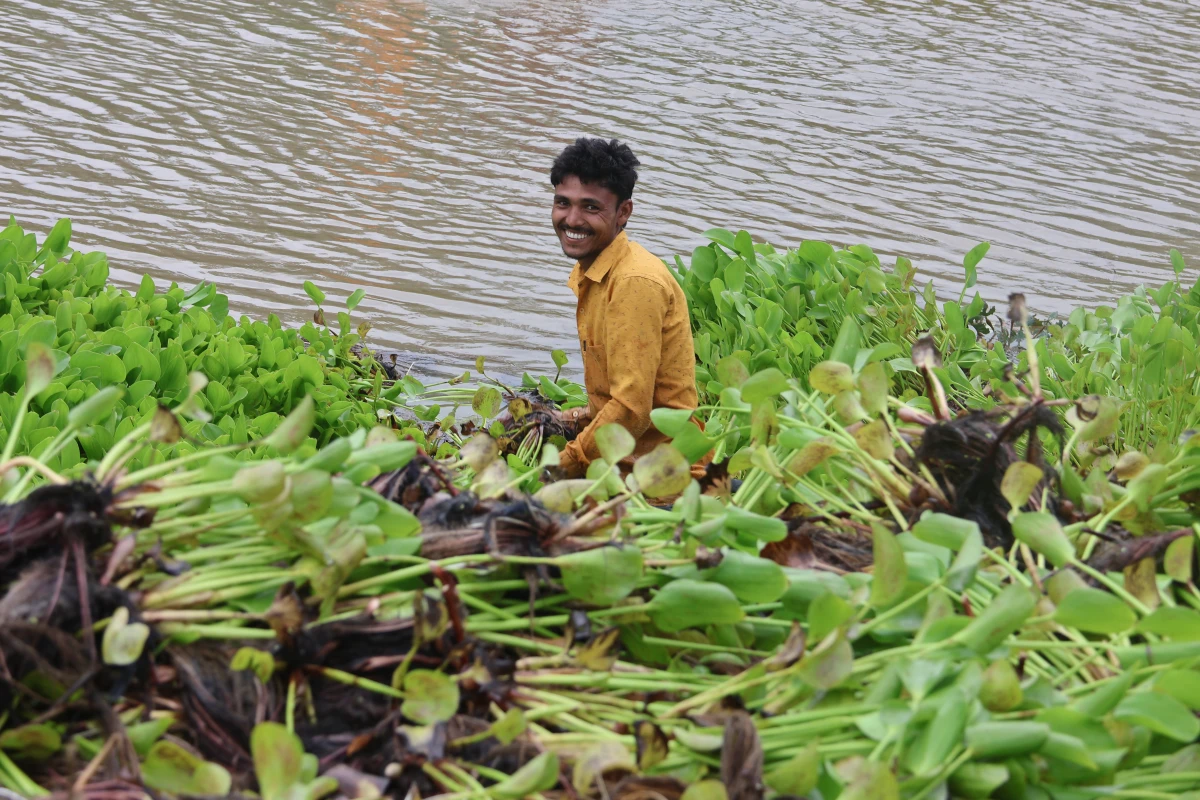
To combat the impacts of drought, 32 community-level Nature-based Solution (NbS) schemes were implemented, including pond restoration, slope protection, and climate-resilient village initiatives. Communities helped rehabilitate ponds, irrigation canals, and vital water infrastructure. These initiatives supported groundwater recharge, recharge ponds, raised handpumps, deep bores, and rainwater harvesting to strengthen both short-term resilience and long-term adaptation for vulnerable communities.
For many women, this work brought something rare: dignity in the form of equal pay.

Bachiya Mukhiya, one of the women participating in the Cash-for-Work programme, shared how different this experience was from past jobs.
“Working here has helped me a lot. I have struggled working in the fields and construction works while doing the same work as men but being paid less. Here, we are paid equally,” she said.
“This pond is very important in our society; we even pray here,” she said. “Being able to clean it is of great help, especially during this drought.”
The wages allowed women to buy basic household necessities and keep their children in school at a time when income opportunities were scarce. Across affected areas, Cash-for-Work provided short-term income to 94 marginalised workers while restoring irrigation for 3,000 bigha (approx. 5010 acres) of farmland and helped clean 7 ponds and 2 canals across 5 municipalities.
In a season defined by scarcity, the response showed that drought recovery could do more than fill gaps; it could strengthen community assets, promote equity, and build resilience from within.
Cash-for-Work: A source of dignity and equality
• Communities repaired infrastructure they depend on daily basis
• Skills and ownership stayed within the community
• Immediate needs were met without creating dependency
• And most importantly—the dignity of earning a living for the family.
Besides Cash-for-Work, 128 FCHVs went door to door promoting safe water storage, efficient water use, purification techniques and hygiene practices reaching 17,413 households. They also raised awareness of diseases like dengue and cholera, as well as Gender Based Violence (GBV) safety during crisis. According to the post disaster monitoring report, the information dissemination through FCHVs led more than seventy per cent of households to show behavioural change, which helped reduce disease risk.
Flooding

After months of intense heat and drought, October brought floods to Madhesh, affecting Rajdevi, Rajpur, and Kaudena. This year, however, the negative impacts on human life were reduced due to better access to information—a result made possible by timely early warning messaging.
Based on DHM forecasts, we promptly disseminated early warning messages to the Community Disaster Management Committees (CDMCs) via WhatsApp and shared real-time updates on Facebook and Messenger. More than 7,900 IVR calls reached residents in flood-prone areas, while a sign-language video was distributed to over 3,400 persons with disabilities. Tailored alerts were issued for high-risk locations, and new WhatsApp groups were established with Community-Based Organisations (CBOs), Civil Society Organisations (CSOs), and CDMCs to ensure rapid coordination. Advisory messages were widely circulated on social media, and mass SMS alerts were activated by integrating key stakeholders and CDMC members into the DHM warning system.
One CDMC member’s actions became a powerful example of how early warnings, combined with local leadership, can save lives. When flood warnings reached Rajdevi Municipality–6, they were sent directly to the CDMCs by RAIN LG officers. Gudu Mandal, a CDMC member, immediately understood the urgency. He mobilised his friends from Mahabhagwati Yuwa Club, and throughout the night, they walked through the village, using microphones to warn residents so that no one would be caught unaware. While others slept, they closely monitored the rising water level.
At around 2:45 a.m., news arrived that the dam was about to burst. Supporting the army, Gudu and his friends rushed to the site, carrying sand and reinforcing the structure with their bare hands. When evacuation became unavoidable, they coordinated with the army and identified a vacant hospital building to shelter displaced families.
Using his own money, Gudu arranged water and fruits for people who had fled with nothing. From the first warning through three days of flooding, he helped evacuate nearly 3,000 people. Alongside 25 friends, he lifted cattle, carried people’s most important belongings on his head, and hauled sandbags to strengthen the dam. Even when his money ran out, and his friends went hungry, they did not stop.
What Turned a Warning into Life-Saving Action
• Alerts reached local leaders before water levels peaked
• CDMCs had clarity on their roles and authority
• Youth groups mobilised without waiting for external aid
• Local knowledge guided evacuation routes and shelter selection
To support families, we worked closely with local governments, wards, and community volunteers to distribute essentials. A total of 1,000 households in Rautahat and Sarlahi received Non-Food Relief Item (NFRI) sets along with dignity and hygiene kits.
To strengthen early action and address accessibility gaps identified in past emergencies, we are restoring and reconstructing inclusive evacuation shelters across Siraha Municipality (Wards 5 and 6), Kamala Municipality (Ward 4), Balawa Municipality (Ward 4), and Rajdevi Municipality (Ward 8). Built to international accessibility standards and designed to be earthquake-resistant, all shelters include ramps for persons with disabilities and disability-friendly washrooms. The facilities provide separate halls for men and women, with dedicated breastfeeding rooms in the women’s spaces. The layout also ensures privacy and dignity for women, including separate internal access routes to washrooms. These efforts ensure that early warning is matched with safe, accessible, and inclusive evacuation spaces for all.
Cold wave
As the monsoon ended, a severe cold spell swept across the Terai. We activated our Early Action Fund, implementing a timely Cold Wave Early Action in line with NDRRMA’s Cold Days and Cold Wave Action Plan.
We focused on supporting Dalit and landless households, children, older citizens, persons with disabilities, and other at-risk groups.

A total of 1,100 winterisation kits, including blankets, woollen caps, shawls, and thermal wear for children under five and older citizens, were distributed across Madhesh and Lumbini Provinces. By prioritising these groups, we helped protect communities from the harsh impacts of extreme cold.
The experiences of 2025 in Madhesh have clearly demonstrated the importance of early warning and, more importantly, early action. Across these crises, the role of local leadership and community response has been evident in reducing risk and protecting lives. When warnings are understood, trusted, and acted upon at the community level, their impact is far greater.
The Resilience, Adaptation and Inclusion in Nepal (RAIN) programme is supported by UK International Development funding led by People in Need Nepal, co-led by Dan Church Aid (DCA) Nepal with Community Self Reliance Centre (CSRC), Local Initiatives for Biodiversity, Research and Development (LI-BIRD), Youth Innovation Lab, Prerana, Red Cross Red Crescent Climate Centre and the UK Met Office. The project focuses on strengthening local resilience by building community agency and preparedness before disasters strike. Working in close coordination with local governments, communities, and the Department of Hydrology and Meteorology, these initiatives combine early warning systems with practical action on the ground. This includes nature-based solutions for long-term sustainability, installation of community sirens, flood measurement systems, mural art for awareness, inclusive risk communication, and accessible, safe shelters designed to be within reach of the most vulnerable. Together, these efforts show that resilience is not built during a disaster—but through sustained, locally led action long before it begins.


